
Dance in Stone
Hybrid performance
Creators:
|
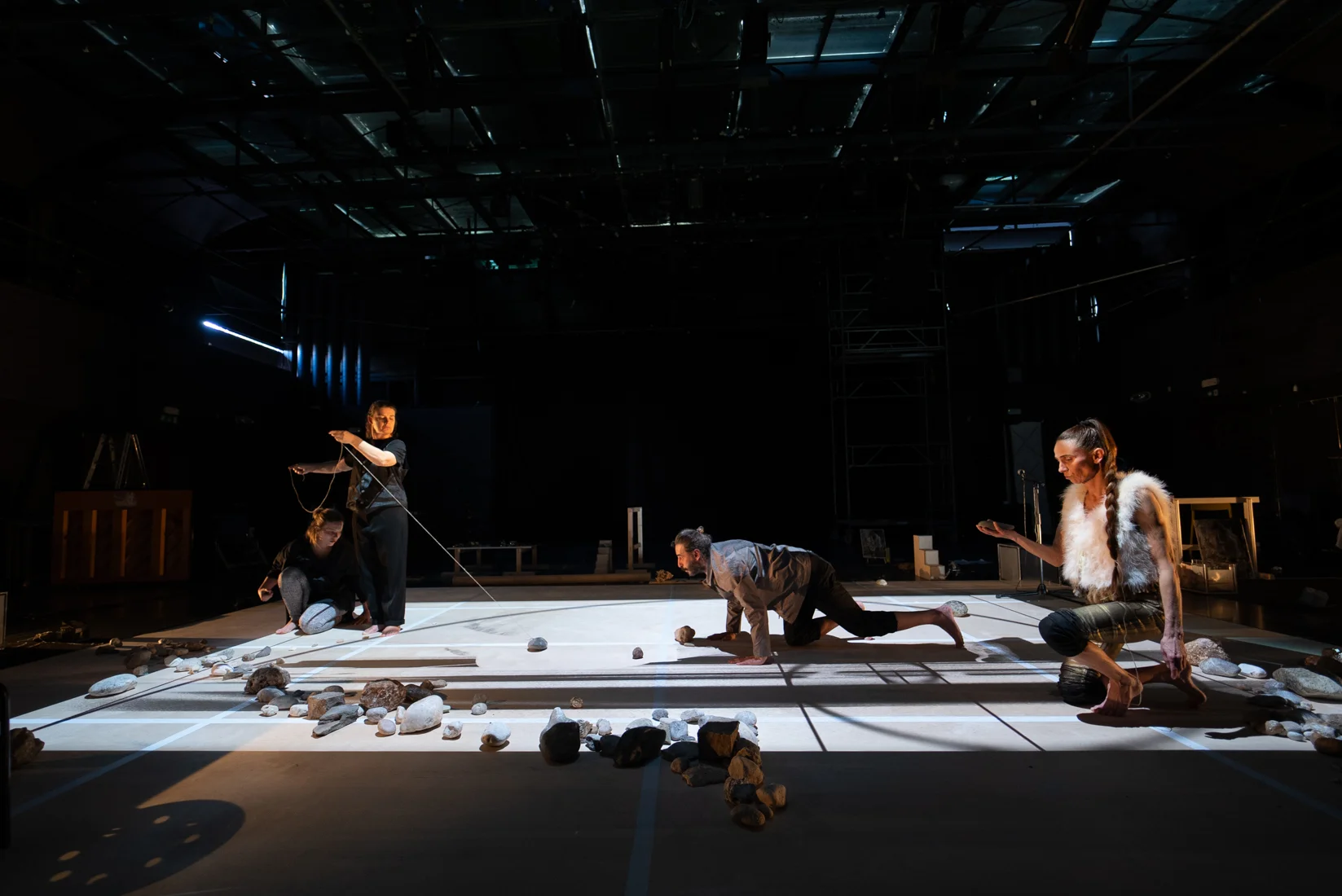
Author, director and choreopgrapher: Leja Jurišić Author of the text: Miklavž Komelj Authors of used texts: Franz Kafka, Jure Detela, Anton Aškerc, Ovidij, Mia Skrbinac, Alenka Tetičkovič Dramaturge: Petra Veber, Leja Jurišić Set, costume and light designer: Petra Veber Co-cretoars and performers: Rok Kunaver, Gašper Malnar, Martina Maurič Lazar, Alenka Tetičkovič, Mia Skrbinac Author of music and the selection: Eduardo Raon Author of video: Atej Tutta Advisor for animation: Martina Maurič Lazar Language advisor: Irena Androjna Mencinger |
Puppetry engineer: Zoran Srdić Stage manager and sound designer: Damir Radončić Producer: Alja Mihajlović Cerar/Katra Petriček Light technician: Maša Avsec Stage technician: Jakob Kozelj Warderobe: Nataša Konić Wrokshops manager: Zoran Srdić Puppet, set, props and costume production: David Klemenčič, Olga Milić, Sandra Birjukov, Lorena Bukovec, Emma Serra Rius, Zoe Špehar, Uroš Mehle, Artiko, Pleksi izdelki Vrhovec We would like to thank: Jiři Bezlaj, Ema Kugler, Andrej Detela, Marko Pogačnik |
Messages Beneath the Stones
I.
What do words do
in this performance with stones as performers?
This performance
is not about what words say about stones,
it is about what stones say about words.
Not how words reach the stones,
but how stones reach the words.
Words and stones obviously share something.
Sometimes we say that something is expressed lapidary.
Meaning worthy of being carved into stone.
The oldest preserved poem written in this city,
in the city that preceded this city,
is written in stone. Written by a slave
to his fellow slave. On display in the National Museum.
Even France Prešeren understood his poetry
as the work of a slave, rather than the work of a master;
in one sonnet he compares himself to “black Africans” in America.
That sonnet is not mentioned in schools.
In the past, schoolchildren wrote on tablets. Made of slate.
Today some say there is too much information,
that we are bombarded by it.
But most of this information also comes from stone.
Instead of carving into stone,
today there is fluidity. But fluidity, too,
comes from stone. All transmissions of information on electronic devices
take place through liquid crystals. Crystals of stone.
All this fluidity is drawn from stone.
Stones are fast, says Leja Jurišić,
who watches the performance with them.
Forgive me: I meant “who makes the performance with them”,
but in actuality Leja did write a performance that was watched by stones.
You, watching the stones,
the stones are watching you.
They make this show.
This performance
is not about what words say about stones,
it is about what stones say about words.
But why should they say anything?
Dreams do with words as with things.
And any living being can turn to stone.
But Mak Dizdar, in his Stone Sleeper, says
that we must unstone ourselves.
Any living being can unstone itself.
Any living being can be born from stone.
II.
Stone
was already at the heart of Slovenia’s most legendary cult classic,
the iconic puppet play,
The Little Sleepy Star.
The story revolves about how the stone
in the bandit’s chest
turns into a living heart.
Stone coming alive.
Whereas, in this performance. we seek
to recognize life in stone.
In stones.
And in this performance, the stones
do not encounter only people,
but also words.
And so the question lingers:
what can words mean to stones?
When we ask this question,
human words may lose all their meaning.
But if they endure,
they may acquire an incredible power.
Can thoughts exist in stone?
III.
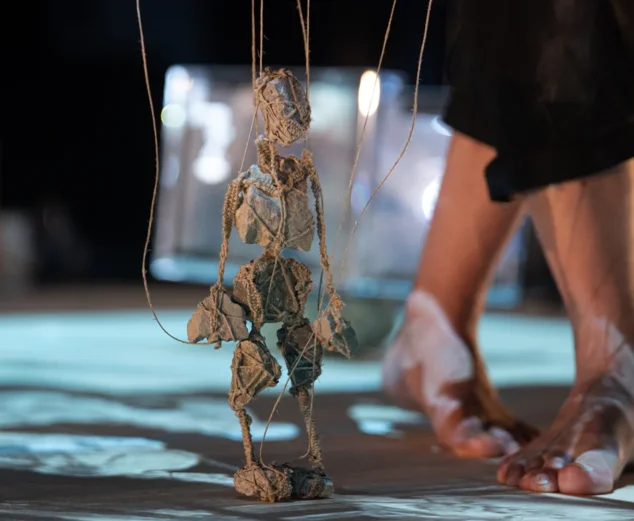
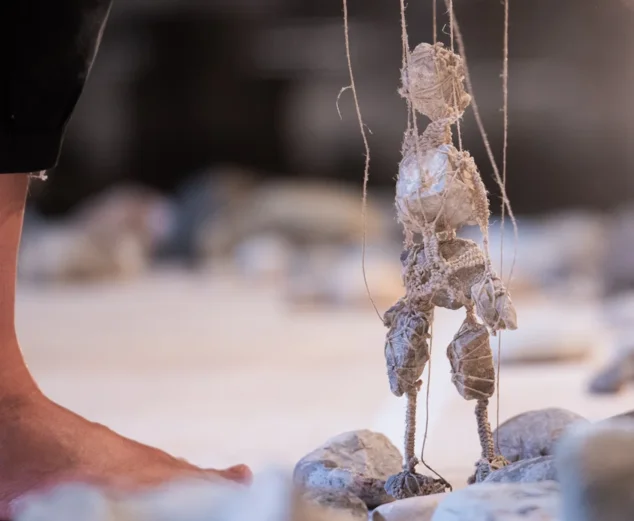
If stones enter puppet theatre—do they become puppets?
If stones enter object theatre—do they become objects?
Are the stones in this performance objects?
But what if they are subjects?
We could argue: “The theatre of stones is a theatre of the subject.”
Sounds intriguing, but rather nonsensical,
even though Slavoj Žižek once said that,
if he had to reincarnate,
he would want to reincarnate as a stone.
The theatre of stones is the theatre of stones.
The theatre of stones is the theatre of stones.
The theatre of stones is the theatre of stones.
Who is watching whom?
Pablo Neruda says in his poem Canto General:
“There is no one. Look at the stones.”
For once, Leja Jurišić set out to flip the script.
She staged a performance in which the stones were the audience.
Watching her performance.
And yet, stones have long been a part of puppet theatre.
The Wolf and the Seven Young Goats—at the end,
they sew stones into the wolf’s belly.
And now we are among the stones.
IV.
We also speak of the Stone Age.
Of the fact that humans, more specifically humans and their ancestors,
spent six million years in the Stone Age.
We call it that because
because what remains from that time are stone tools.
For a long time, the use of tools
was considered what sets humans apart from animals.
Much later it was discovered that tools similar
to those used by humans in the early Stone Age
can also be used by chimpanzees.
Also surviving from the Stone Age are paintings,
and they are sublime.
No human paintings surpass those of the Stone Age.
The cave art that survives
is not six million years old,
it is around thirty thousand years old.
This is painting at its finest.
This is art at its finest.
The idea of progress in art is nonsensical.
Djuna Barnes referred to herself
as an early Stone Age woman.
And she was right.
Looking at the paintings from the early Stone Age,
for instance, those in Chauvet Cave,
one is struck by their remarkable fluidity.
One could even argue
that they knew film back then.
An expert on painting,
while examining the paintings in Chauvet Cave,
30,000 years old,
acknowledged that we essentially know nothing about them.
We essentially know nothing, and yet we can tell everything from them.
We can tell, for example,
that the society of those people was very much unlike ours.
From the way the animals depicted on the
walls of Chauvet Cave are arranged,
and from the arrangement between those animals and the cave walls,
we can clearly tell
that the people who painted them
had no concept of private ownership.
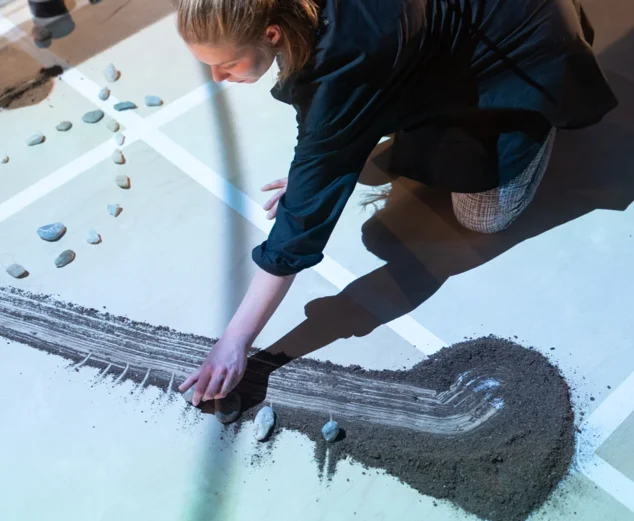
Can there be emotions in stone?
V.
Partisans, too, watched stones,
the theatre of stones.
Bogdan Osolnik once told me
what it was like among the partisans at Base 20,
the main base of the Central Committee of the Communist Party
of Slovenia and the Executive Committee
of the Liberation Front.
Next to the barracks in the forest
there were stones,
rocks protruding from the ground.
And the partisans who were there
would sit in front of the barracks in the evening
and talk,
but the most magical thing of all were the stones.
The partisans watched the stones
which, at night by the fire, cast magical shadows.
They were utterly magical.
The most wonderful thing there, Bogdan Osolnik said,
were those stones.
And the way the partisans watched them.
The birth of the revolution from the spirit of stone.
The birth of the revolution from the spirit of stone.
The birth of the revolution from the spirit of stone.
Those stones are still there.
Those rocks protruding from the ground.
Metka Krašovec, meanwhile, once told me
how after the war, on the Brijuni Islands, Koča Popović,
a surrealist who, during the partisan revolution,
became the commander of the legendary 1st Proletarian Brigade,
left love notes
for a woman he secretly loved
under the stones.
VI.
Ultimately, it is a dance.
A short poem by Jure Detela reads:
“Be in the stone, magical dance;
dreams have come from above;
thoughts are moving!”
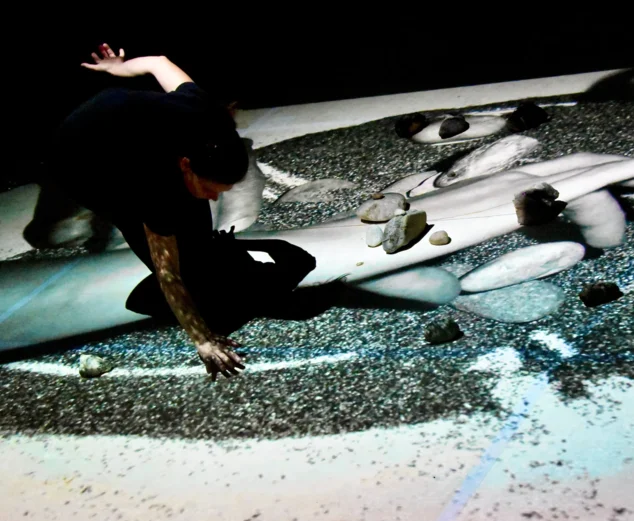
Though stone is normally perceived as inanimate and immobile,
this performance seeks to uncover the dance within it,
exploring how that dance
relates to dreams and thoughts.
Dance in stone
seeks to reveal life within the stone itself,
without the need to transform it.
In this, it follows what
was expressed in one of the sonnets
by Michelangelo Buonarroti:
The greatest artist does not have any concept
which a single piece of marble does not itself contain.
But this performance does not carve stones.
It does not use stones as material.
If we wish to become partners in the dance within the stone,
we must unstone ourselves.
Can there be movement in stone?
VII.
We should also mention Pier Paolo Pasolini.
A few days after the premiere of the performance will mark the fiftieth anniversary of his death.
Pasolini loved reality infinitely.
And reality in its complexity and contradiction,
without dialectical resolution,
has perhaps nowhere been described more directly
or more lapidary
than in a description of a stone.
The stone description from his novel Petrolio.
This stone is what a saint deceived by God-Devil was transformed into
after falling from the third heaven:
“The infinite variety of its soft colours corresponds to an infinite variety of materials, but none of them have really been identified, because each mineral presents contradictory characteristics, both in relation to itself and in relation to the other minerals with which it is amalgamated or compounded; it has not been possible to distinguish in that rock what appeared precious from what appeared to be worthless or even toxic; it has not been possible so far to determine if the analysis is impossible and the contradictions absolute […].”
And another thing: As a child, Pasolini spent
a little under a year
in Idrija, today’s Slovenia.
And this affected him deeply.
And especially the stones affected him.
Real stones are from there.
In the text An Hour and Fifty Minutes from New York, Pasolini writes:
“I smell the valleys without grass.
I would never be a priest,
a blackmailer who screams like revelations
the concepts rationally common to his circle:
for this reason, I do not see the stones and rocks as ideograms.
I see real stones, the ones from the mountains of Idrija.”
How can one bring stones to life,
if the soul is already within them?
POST SCRIPTUM
At one point, Martina Maurič Lazar called the process involving stones a temple of associations.
Gašper Malnar was amazed at how easy it is to fall in love with stones.
As a little girl, Alenka Tetičkovič was once gifted a box of chocolates. She saved them for special occasions, carefully rationing them. One day she opened the box and picked up a strangely heavy chocolate. After unwrapping it, she found a stone inside. The same was true of all the remaining chocolates. Her brother then explained that chocolate sweets turn into stones if you do not eat them quickly enough.
It turned out that Rok Kunaver was indispensable to the performance. the clue was there from the start, in his name: Ro(c)k.
Mia Skrbinac brought Mak Dizdar’s unstoning into the performance.
Ljubljana, October 2025
|
Published by Lutkovno gledališče Ljubljana Represented by Uroš Korenčan, general manager Artistic director: Mare Bulc Season: 2025/2026 |
Prepared by Benjamin Zajc Photos: Gregor Gobec |
LUTKOVNO GLEDALIŠČE LJUBLJANA
KREKOV TRG 2, 1000 LJUBLJANA, SLOVENIA
T 00386 (0)1 300 09 82 / 00 386 (0)80 20 04
E BLAGAJNA@LGL.SI
WWW.LGL.SI
ONLINE TICKET SALES
 |
 |
Sponsors of the theatre
 |
 |